

By: Alex Tveit and Norman Valdez
Mental health is part of our well-being— it’s an anchor in our ability to navigate the complexities of life. Over the past few years, we’ve been subjected to unrelenting stressors: a global pandemic, ongoing conflict in Ukraine and the Middle East, and an escalating climate crisis. These and other worldwide challenges weigh heavily on our collective psyche. Yet there is one rapidly developing force that, for many, is adding another layer of anxiety to an already burdened society: Artificial Intelligence (AI).
A New Kind of Anxiety
AI technology feels like the “new kid on the block”—equal parts exciting and intimidating. On one hand, innovations such as large language models and automation promise increased efficiencies and novel solutions to a wide range of problems. On the other, the breakneck pace at which AI systems evolve can be unsettling. People worry about the implications of these new tools and how thoroughly we understand their long-term societal impact. These concerns are starting to be especially pronounced among young people, who are acutely aware that they will live with the ramifications of today’s AI developments for decades to come.
It is vital to acknowledge AI-induced anxiety in the same way we do other large-scale stressors. Just as climate change and economic uncertainty have gained mainstream recognition as major contributors to mental distress, so should the psychological effects of AI. If we are to address these anxieties effectively, we must first recognize them as real and worthy of prevention, treatment, and public awareness.
We’ve Seen This Before: Climate Anxiety
The environmental crisis shares a similar global breadth and existential heft in our collective consciousness. “Eco-anxiety,” also known as climate anxiety, has become increasingly prevalent. A study found that 84% of youth aged 16 to 25 reported being moderately worried about climate change, with 59% expressing extreme concern. The long-term stakes of climate change—potentially irreversible ecological damage, including loss of biodiversity—magnify these worries. Now, a similar sense of urgency is emerging around AI: if we do not govern it responsibly, the outcomes could be equally irreversible, albeit in different ways.
AI Anxiety Among Youth
AI is no longer confined to science fiction. From AI-driven surveillance—like the Toronto Police Service’s use of facial recognition tools—to biased social media algorithms, it pervades every facet of daily life. As AI’s capabilities expand, young people find themselves living in a world that is shaped by complex machine decision-making. Projections suggest that AI will continue to grow in influence, automating an ever-broadening range of tasks and it is already starting to transform entire industries.
This anxiety is even more pronounced among Indigenous Peoples, Black communities, and refugees or newcomers—groups who already grapple with systemic barriers in education and employment and growing digital divides.
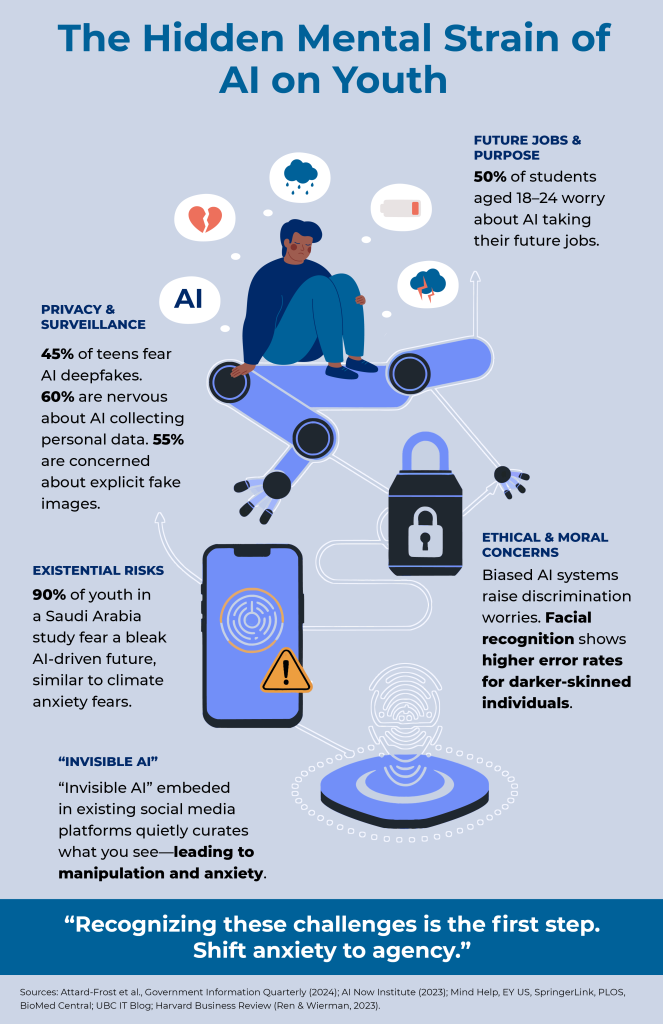
A Balanced Approach: Avoiding Doomism While Staying Urgent
Given the mix of responses among youth—from anxiety to enthusiasm—how can we collectively address the situation? The key is balance. We must take youth concerns seriously without succumbing to doom-and-gloom fatalism that paints young generations as inevitably traumatized by AI. Overstating the catastrophe can be as harmful as downplaying the risks; it either paralyzes youth with fear or makes them tune out the warnings entirely.
Beyond AI: The Threefold Anxiety in Canada
While AI-induced anxiety is growing globally, in Canada, young people are grappling with multiple layers of existential worry. Studies show that climate change anxiety is also pervasive among Canadian youth. On top of this, there is an acute housing affordability crisis that adds financial and social stressors, compounding mental health challenges. Taken together, the cumulative impact of AI, climate change, and housing costs contributes to a sense of uncertainty about the future.
Addressing these interconnected anxieties requires a holistic approach. Balanced media narratives, educational reforms that include AI literacy, and robust mental health support systems can alleviate the combined weight on youth.
Let’s Address this: A Multi-Sector Approach
1. Educational Initiatives
- Promote Education and AI Literacy
Misinformation and misunderstanding fuel anxiety. Schools and communities can provide forums for young people to learn what AI is and isn’t. This includes integrating basic AI literacy into curricula—explaining how algorithms work, discussing their limitations, and debunking popular myths. Education can also cover AI’s socio-economic impacts, so youth have a realistic picture of which jobs might change and which human skills will remain vital (e.g. creativity, critical thinking, interpersonal skills). Empowering students with knowledge gives them a sense of control. As one mental health guide put it: “Stay informed but not alarmed”.
- Parental Guidance
Engaging and educating parents is key. Targeted programs aimed at parents can equip them with the necessary tools and insights to support their kids, ensuring that as AI integrates more deeply into our lives, families are well-prepared to handle its challenges together.
- Bridging the AI Gap
Instead of relying solely on educators, schools could consider creating educational “add-ons”—modular, flexible programs that integrate the latest innovations in technology. These add-ons can help bridge the gap between traditional curricula and the dynamic world of AI, ensuring that students are always exposed to up-to-date content, regardless of the pace of change. This could also be accomplished through collaboration between formal and informal education initiatives.
2. Policy and Regulation
- Encourage Agency and Involvement
One of the best remedies for anxiety is taking action. This is evident in climate anxiety, where engaging in activism or solutions tends to reduce helplessness. Similarly, with AI, giving youth a sense of agency can transform anxiety into empowerment. At a community level, schools can involve students in drafting guidelines for AI use (e.g. a student committee to advise on a school policy for AI tools in classrooms). At a broader societal level, policymakers and tech companies can incorporate youth voices when shaping AI governance. A recent qualitative study suggested that when children and youths are included in decision-making about AI—say, in healthcare or education—it helps build trust and “social license” for AI in their eyes.
- Transparent Governance
Recent research highlights a need for governance structures that openly disclose the environmental and social costs of AI. This transparency can mitigate anxiety by offering a clear roadmap for accountability.
3. Technological (and AI) Stewardship
- Highlight Positive Uses of AI, Balancing Our Approach
We can promote AI’s potential for good, not just its threats. Focusing on solutions and progress can alleviate some of the worry and inspire engagement rather than avoidance. - Collaboration with Indigenous Peoples
Indigenous Peoples have long histories of environmental stewardship. Drawing inspiration from this synergy, the Abundant Intelligences research program seeks to integrate Indigenous Knowledge systems with artificial intelligence. By embedding AI within Indigenous frameworks, this initiative aims to create technologies that resonate with cultural values and ethical considerations, ensuring that AI development respects both ecological boundaries and cultural heritage.
4. Community Engagement and Support Systems
- Mental Health Services
Greater access to counseling, peer support, and community dialogues can help young people manage AI-related anxieties. Strengthening existing mental health infrastructure ensures that those grappling with uncertainty about the future find the resources they need. - Promoting Balanced Narratives
Media and storytelling play a powerful role in shaping public perceptions. Highlighting success stories—like youth-led AI initiatives that combat climate change or improve healthcare—can inspire hope and reassure that technology can be harnessed for positive impact.
Building a Hopeful Future
Fostering Innovation and Creativity
Many youth are beginning to approach AI not with dread, but with a sense of possibility. From high school hackathons to university-led research groups, young people are experimenting with ways to leverage AI for societal good. This aligns with the Green AI movement, which seeks environmentally responsible AI solutions. By nurturing these initiatives, offering mentorship, and providing grants or seed funding, we can empower the next generation to direct AI towards challenges like climate adaptation, inclusive healthcare, and sustainable agriculture.
Storytelling and Media Representation
Public perception of AI is often shaped by sensationalist headlines and dystopian science fiction. While cautionary tales have value, balanced and evidence-based representation matters. Documentaries, social media campaigns, and community-driven narratives can illuminate AI’s real-world capabilities and its tangible potential for good. Elevating youth perspectives in these stories ensures that emerging generations see themselves as shapers, not just bystanders, of an AI-driven future.
Unlocking (Youth’s) Collective Imagination
One compelling idea from thought leaders like Geoff Mulgan is the concept of an “Imaginary Crisis.” While it can fuel unproductive fears, it can also be harnessed as a powerful spark for collective imagination. The mere possibility of “worst-case AI scenarios” pushes societies to ask difficult, visionary questions—What if we reimagine AI as a tool for environmental rejuvenation? How might it dismantle, rather than deepen, systemic inequities? Embracing the constructive side of an “Imaginary Crisis” encourages us to conceive bold innovations, policies, and civic structures that proactively shape AI’s trajectory. By leveraging imagination, we empower youth to channel their anxiety into creative action, forging pathways that prioritize ethics, resilience, and justice.
A Holistic and Hopeful Path Forward
As AI continues to weave itself into every aspect of modern life, its psychological effects—especially on younger generations—deserve close attention and proactive support. Yet, we shouldn’t accept doom or passivity as the prevailing narrative. By bolstering mental health services, embedding AI literacy into our education systems, fostering ethical stewardship, and placing youth at the center of decision-making, we can transform anxiety into agency.
In doing so, we lay the foundations for a new era in humanity’s story—one where technology can serve as a bridge to a more equitable, sustainable, and inspired future. Ultimately, an inclusive, imagination-driven approach that leverages collective wisdom is our best path to ensuring that AI becomes not a burden but a beacon of human potential.
References & Further Reading
- Attard-Frost, B., Brandusescu, A., & Lyons, K. (2024). The governance of artificial intelligence in Canada: Findings and opportunities from a review of 84 AI governance initiatives. Government Information Quarterly, 41(2), 101929. https://doi.org/10.1016/j.giq.2024.101929
- AI Now Institute (2023). The 2023 Landscape: The Climate Costs of Big Tech.
- Mind Help; EY US; SpringerLink; PLOS; BioMed Central — sources detailing AI-induced anxiety, climate change anxiety, and housing affordability crises.
- UBC IT Blog: Discussions on the environmental impact of AI and the concept of “Green AI.”
- Harvard Business Review: Ren, S., & Wierman, A. (2023). The Uneven Distribution of AI’s Environmental Impacts.