
This article is written by 2025 CFC Transformation Storytelling Fellow Kat Cadungog, in collaboration with the 4Rs Youth Movement and Social Innovation Canada
Ten years on from the Truth and Reconciliation Commission and the Philanthropic Declaration of Action, philanthropy must reckon with how they have shown up (or not shown up) for Indigenous-led and serving organizations. Was signing the declaration lip service or a true moment of transformation? This question brings a shared ache and sector-wide confrontation that more must be done as advancing Truth and Reconciliation cannot be the sole work of Indigenous Peoples.
To shape philanthropy’s decolonization journey, it is essential that it reflects on how it has historically benefitted from and continues to benefit from the suppression of Land Back.
Land Back is not only about returning land, but also about transforming the systems that shape how Indigenous and non-Indigenous Peoples engage with it. This has direct implications for philanthropy, given that much of its wealth is rooted in land and capital, at one point taken from Indigenous Peoples.
So, how will philanthropy respond when the opportunity to participate in Land Back is right in front of them? The reclamation project at Wasan Island, initiated by the 4Rs Youth Movement, Winnipeg Boldness, and Social Innovation (SI) Canada presents an invitation.
Grounding at Wasanay Mnising
Wasanay Mnising (colonially known as Wasan Island), in its most recent years, has been a gathering place for social impact leaders to retreat and tackle pressing issues. Yet, its history runs far deeper. For generations, the surrounding area of Wasanay Mnising was used as a corridor for trade, ceremony, and relationship-building to connect neighbouring Indigenous communities. Nikeeta Tabobondung, member of Wasauksing First Nation, and the Community Bridge builder for the Wasan Land Back Initiative, described Wasanay Mnising as a place of light, fasting, and rebirth. She shared that Wasanay Mnising roughly translates to “Torch Light Fishing Island,” marking its unique shallow shelves for spearfishing and establishing it as a place of light.
“In reference to that light, to Wasan Island, the place calls to you. It’s a place where people would participate in ceremonies, as well as a place people would go to pass away to the next stage of life. It was also used as a place of fasting as well, referencing parts of yourself where you can shed old concepts of thinking and perception, be reborn and new, and come out with new perspectives and visions… a renewed sense of self.”

Yet, many First Nations (including the Wasauksing, Moose Deer, Rama, Beausoleil, and Wahta Mohawks), who for generations travelled those waters by birchbark canoe, stopping at Wasanay Mnising as they moved through Lake Muskoka, are seldom seen.
Today, the Muskokas are known as “cottage country,” with stretches of shoreline dubbed “billionaires row.” The very Peoples who once held ceremonies on these lands are now among those most excluded from spaces of retreat and refuge like Wasanay Mnising. This exclusion is not accidental or natural but a deliberate colonial project to violently remove Indigenous Peoples from their homelands, both physically and culturally. The absence of Indigenous presence was andis by design. The struggle of Indigenous Peoples to return is proof that this suppression is not just history, it is ongoing and active today.
Without space, the work of language learning, healing, and reconnecting to land can feel insurmountable. Karen Joyner-Blom, Director of Communications and Community Outreach at Eenou-Eeyou Community Foundation, connected this to the profound loss of young people. What’s missing are places Indigenous youth know they belong to, spaces that allow youth to deepen their knowledge of their territories, reclaim identity, and feel held by the land. Yet these spaces remain largely inaccessible.
Andrea Nemtin, as a settler-ally from Social Innovation Canada, named this conflict she had been feeling over the last few years as a visitor to the island. A common sentiment was shared amongst her peers, people with privileged access to Wasanay Mnising and often non-Indigenous, that they were “start[ing] to feel uncomfortable—there was a real question of who got to go and who didn’t. We all knew Wasan was an important piece of infrastructure in our sector, but there was a growing unease around access and inclusion.”Returning to the land is prohibitively expensive, and Indigenous communities are forced to compete with the high prices of retreats in places like resorts, cottages, camps, such as in the Muskokas or the Blue Mountains. The result is that wellness, rest, and reconnection are treated as luxuries when in truth, they are lifelines.
The Hope and Vision for Wasnay Mnising
When Wasanay Mnising went up for sale in 2025, Indigenous leaders including Diane Roussin, Jess Bolduc, and Nikeeta Tabobondung, came together to envision its future, with support from Andrea Nemtin and a circle of philanthropic allies. This collective effort opened the door to restoring Indigenous connections with land and culture, and to re-imagining partnership with settler peoples.
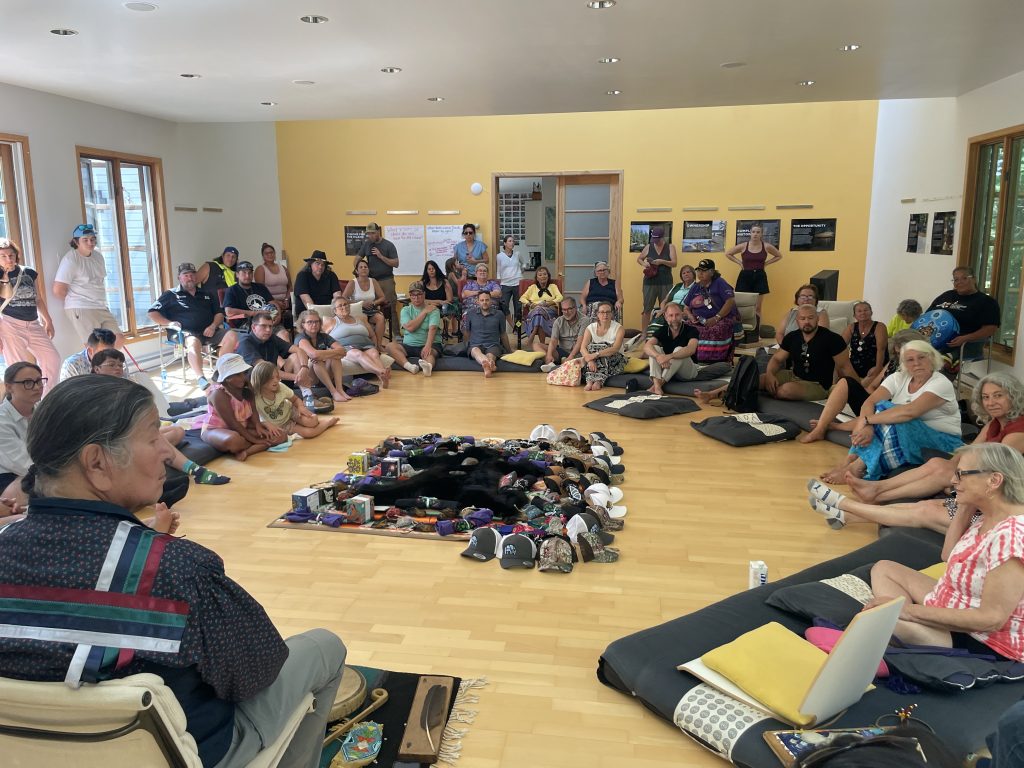
“A root to this project is rekindling, hoping that through this land back , that it’s not just about one community coming back, it’s a homecoming for each of those nations. A reconnection with a small parcel of their traditional territories.”
Nikeeta Tabobondung
Over the past few months, the team has been working with Bruce Lawson, The Counselling Foundation of Canada, to develop a campaign to raise capital and funding for Wasanay Mnising to come under Indigenous management and use. The approach has centred Indigenous leadership. Partners emphasized stepping back from a “hero” mindset, focusing instead on making each step thoughtful and collaborative, rather than rushing to an outcome at all costs.
While Wasanay Mnising is the focal point, the project is also a pilot for how Land Back can be practiced more broadly: a tangible example of reconciliation in action that broadens the responsibility of philanthropy to include reparations, and a contribution to the wider Land Back movement. The challenges are significant. Beyond purchasing the land, the island requires renovations, ongoing operating funds, and administrative capacity to manage it.
The Story of Wasnay Mnis, in Indigenous Voice
The less tangible obstacle is resistance from those who feel threatened by an Indigenous return to Wasanay Mnising. Land ownership in Muskoka carries an entrenched sense of elitism, and hostility can run deep. In response, the team is turning to truth-telling and relationship-building with neighbours, reminding them that Indigenous Peoples are still here and deserve to gather in Mnidoo Gamii and Musko’Ki territories (colonially known as Georgian Bay and Muskoka) too.
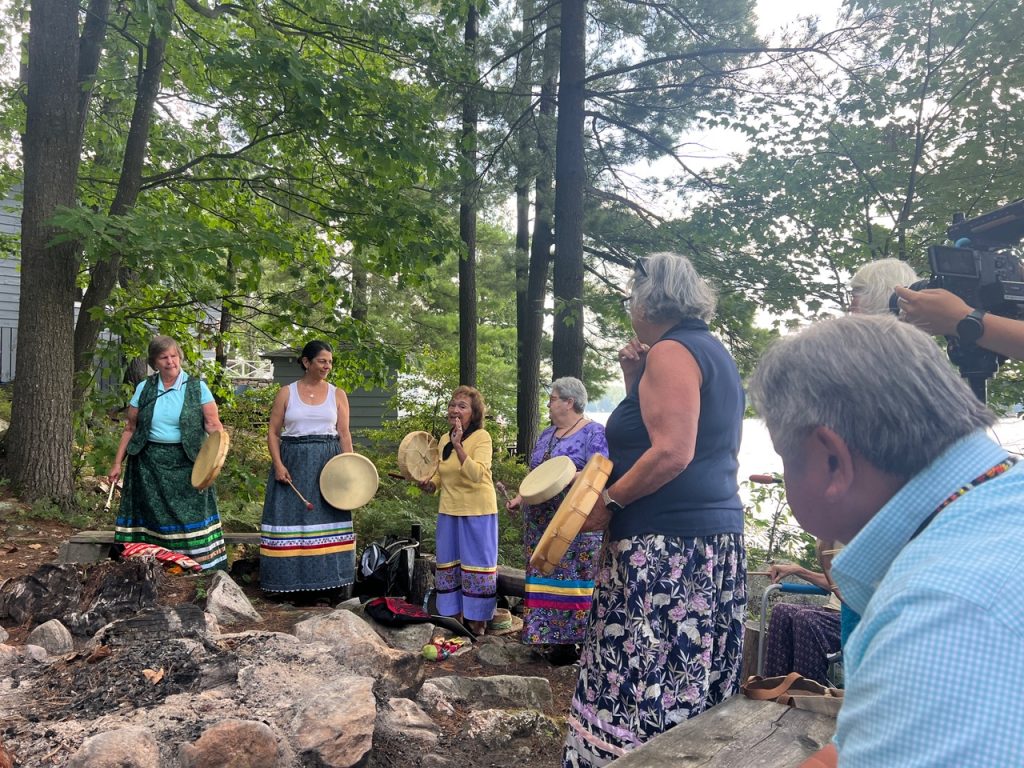
Importantly, Indigenous Peoples are taking the lead to tell their own story, and the story of Wasanay Mnising, in their own words. After generations of others speaking on their behalf and missing the heart of the land, planning is underway for the filming of a documentary that centers around the history of the island as told by the Anishinaabek, and other Nations who have ancestral and post-colonial ties to the area. The documentary will be filmed and directed by Rebeka Tabobondung, led by MUSKRAT Media Collective, as a way to articulate the benefit of returning lands to Indigenous stewardship. The film is also envisioned to be used as a legacy of history and knowledge to be gifted back to community archives, while also supporting the community engagement process and capital campaign.
The Call to Action
Wasanay Mnising is a chance to show that Land Back starts with centering Indigenous voices and enabling their vision. Philanthropic partners are called to become part of this movement through contributing to the capital campaign, learning about Land Back, and helping to ensure this living legacy thrives. A clear first step in your decolonization journey is to sign on in support of calls to action outlined in UNDRIP (United Nations Declaration on the Rights of Indigenous Peoples). Jess Bolduc, shares that aligning goals with UNDRIP supports philanthropic organizations to better understand rights-based approaches as a practical framework to advance reconciliations efforts. The next step as a philanthropic ally would be to sign and/or renew your commitment to the Philanthropic Declaration of Action.
Local community leaders and Indigenous members, bolstered by a growing group of supporters, are leading the way, working hard to return Wasanay Mnising back into Indigenous stewardship. Every movement has a turning point. For reconciliation, that moment may be unfolding on a small island in Muskoka called Wasanay Mnising.
Get Involved!
- Sign up here for further updates and to be notified about the upcoming webinar.
- Read about the current Wasanay Mnising Land Back Initiative: Wasan Island Land Back Retreat – Summary Report
- Read about The Counselling Foundation of Canada’s blog post: Advancing Land Back and Reconciliation: The Wasanay Mnising Rematriation Initiative
Interested in reading more? Check out:
- 4Rs Youth Movement, “Land Back, What do we Mean”: https://4rsyouth.ca/land-back-what-do-we-mean/
- 4Rs Land(ing) Back Podcast Series & Policy Paper (In collaboration with Youth Climate Action): https://4rsyouth.ca/landing-back-audio-blog-series/
- The Circle, I4DM Definitional Matrix for Funders: https://the-circle.ca/media-and-publications/the-i4dm-definitional-matrix/
- Mno Aki Land Trust: https://mnoaki.org/
- Songor’ea Land Trust, “What is Matriation”: https://sogoreate-landtrust.org/what-is-rematriation/
- Ulnooweg Education Centre, “Windhorse Farm to Asitu’lɨsk”: https://ulnoowegeducation.ca/windhorse-to-asitul%C9%A8sk/
- Yellowhead Institute Land Back Online Course: (https://learnonline.yellowheadinstitute.org/ (Also check out their reconciliation report card here: https://yellowheadinstitute.org/report/trc/)