
This is part of our Healthy Communities Initiative series, showcasing how the $60 million investment from the Government of Canada is supporting communities as they create and adapt public spaces to respond to the new realities of COVID-19.
Chantelle Grafton has been an avid mountain biker since 2013. “My husband bought me my first bike, and I loved it. We have amazing trails around Prince George,” Grafton said, referring to the area around her home in BC.
In 2019, Grafton had an accident where “I broke my neck at C1, 2, and 3, so now I’m quadriplegic and I have no functional movement below my shoulders.”
Through social media, Grafton found an adaptive buggy, which she and her husband continued to tweak to Grafton’s requirements. She says that, while operating the buggy took a lot of troubleshooting at the start, she’s now able to “do exactly what I love doing with the people that I used to love doing it with, and it felt completely normal.”
Grafton explains that part of the transition to using a wheelchair is that “you’re always surrounded by people who are wanting to help, which is great, but you still just want to get out there and be in nature and be with your pet.”
With her adaptive buggy, Grafton has been able to continue cycling in some of the parks that she loved, especially through the Prince George Cycling Club (PGCC), an inclusive cycling group which promotes all forms of cycling (road, mountain and urban), as well as providing its members with a social network through events and workshops.

Canadian Tire, the University of Northern BC, and the Graftons donated money for the purchase of an adaptive bike that the community can use anytime. In addition, the PGCC collected donations that were used towards the purchase of a bike carrier rack for the adaptive bike, to transport it safely between rides.
“There’s definitely more of a drive these days to make trails that are suitable for adaptive cyclists,” says Bret Hutchinson, PGCC’s Pidherny director, explaining the many types of accessible bikes available, from trikes (vehicles with three wheels), to bikes operated by hand, and e-bikes.
As well as access to adaptive trails, PGCC offers space for the community to connect, which was especially important during the pandemic. “Looking at it from a perspective as an adult, it’s incredibly hard to make friends,” Hutchinson says. “You need clubs like this for people to be able to go out and meet other people who also want to do positive things.”
Hutchinson adds that people with disabilities may face barriers to experiencing nature as easily as able-bodied people. “That’s really where this drive came from — to make more trails so that people who have a disability have easier access to experience nature,” he says.
Transforming bike trails
In hopes of making cycling more accessible, PGCC applied to Community Foundations of Canada’s Healthy Community Initiatives (HCI) funding through the Prince George Community Foundation.
Through the HCI funding, PGCC was able to modify an existing trail in Pidherny, making it suitable for adaptive cyclists. This meant making the trail wider in certain areas, getting rid of puddles and fixing drainage issues. In areas where it was too challenging to modify the trail, bypasses were added in.
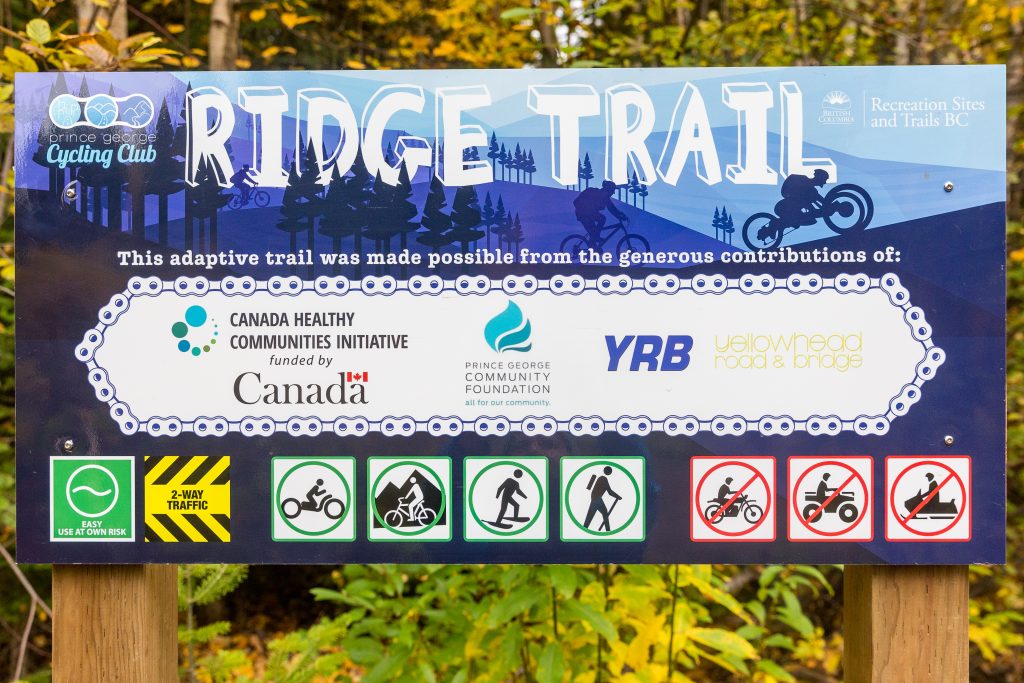
Partner organization, Yellowhead Road and Bridge, worked on the first 700 metres of the trail, and with HCI funding, PGCC was able to cover the remaining 2 kilometres.
“I think the importance of [PGCC] is giving people opportunities that wouldn’t exist otherwise,” shares Hutchinson. “Especially with the community that we’re supporting, they have enough challenges as it is. There aren’t many people who are necessarily coming out to volunteer to help that community, which is sad, but that’s the reality. The [HCI funding] allows us to do projects like we did, where otherwise it wouldn’t have happened.”
Grafton says that the adaptive trails are “a huge deal because for a lot of these people it’s their first time being on a trail in maybe decades,” Grafton said. “Even if it’s one person that gets out there, I think it’s so worth it.”